
Yonkers Previous Residents by Era
The record trail changes with the era. Recent municipal roll material is a snapshot rather than a complete title history. A deed can supply dated transfer parties and a legal description, while a reverse directory can place a printed listing at an address in only its own edition. Begin with the source whose date is closest to the question, then test it against an independent record.
| Source | Years It Covers | Where Held | What It Shows |
|---|---|---|---|
| City assessment rolls | Published final rolls for 2024, 2025, and 2026 | Yonkers Assessment Department | A dated municipal property snapshot |
| Westchester Records Online | Public landing describes 18th-century deeds through recently entered legal records | Westchester County Clerk | Recorded-instrument discovery, subject to access limits |
| Yonkers reverse directories | 1895-1900 and 1900-03 | YPL Riverfront Local History Room | Address-oriented historical listings |
| Yonkers criss-cross directories | 1931, 1936, and 1939 | YPL Riverfront Local History Room | Later address-oriented listings |
| City-directory and newspaper collections | Directories from 1858 through 1939 with gaps; newspapers by titled run | YPL Riverfront | Dated household and event context |
The County Clerk's online service is a convenience database that is periodically updated. It is useful for discovery, but official records remain accessible at the Clerk's office. Use the County Clerk's Land Records Division, rather than a general FOIL request, when a deed or another land record is needed.
Start Yonkers Previous Residents With a Parcel
An address can change while the legal description remains the better link between records. The Yonkers Assessment Department creates annual rolls that reflect condition, ownership, boundary, and exemption changes. Its legacy Image Mate route describes public RPS data, tax maps, photographs, and a section-block-lot format of 9.-9999-999.999. Record the street address as shown, the municipal print key or SBL, the municipality, and the source date.
The county municipal tax-parcel viewer supports municipality, address, print key, and owner-name-if-available searches. Its schema separates situs fields from owner mailing fields. That distinction matters for previous residents: an owner mailing address is not proof that the owner lived at the parcel, and the parcel layer is not a household list. The published boundaries are approximate, not a survey or final boundary description.
Yonkers Image Mate is the documented public starting point for the city roll, tax-map, and property-photo route.
Tracing Yonkers Owners Through Deeds
The backward deed trail starts with the present parcel reference, not a name-only search. Westchester Records Online has Land Records, Legal Records, Maps, and Trades branches. Its public material supports broad historical discovery, while images or reports require an account and payment. The authenticated Land Search fields and document filters were not verified during research, so do not assume a particular online query option exists.
- Capture the current address, print key or SBL, and any legal-description clue from the municipal or county parcel reference.
- Use Westchester Records Online to seek a recorded instrument through the available land-record route.
- Save the grantor and grantee names, instrument or book-page reference, parcel identifiers, legal description, and recording date.
- Search the earlier party and the legal description for the preceding transfer instead of relying only on the modern address.
- Ask the County Clerk Land Records Division about counter access or a certified copy when the remote record does not answer the question.
- Grantor and grantee
- The grantor is the party transferring an interest. The grantee is the party receiving it in the recorded instrument.
- Chain of title
- A chronological series of recorded transfers connected by parties, parcel clues, and legal descriptions.
- Legal description
- The property wording used in land records. It can preserve continuity where a street address has changed or is absent.
Land Records staff cannot give title or legal advice. A WRO result can identify a lead, but a Clerk-prepared certified copy is the legally equivalent copy when that distinction matters.
Westchester Deed Access for Yonkers
The Westchester County Clerk keeps recorded land instruments separately from Yonkers municipal assessment material. Its Land Records Division is at 110 Dr. Martin Luther King Jr. Boulevard, White Plains, and the Clerk's public office is entered through the Richard J. Daronco Courthouse at 111 Dr. Martin Luther King Jr. Boulevard. The listed weekday hours are 8:30 a.m. to 4:30 p.m., and the main number is 914-995-3080.
The Westchester County Clerk's divisions page is the official office route, while WRO is the online discovery entry point. Use a narrow request that names the parties, approximate recording range, legal description, SBL or print key, and address if known.
Westchester County Archives reading-room guidance describes the archival route for older county-created materials.
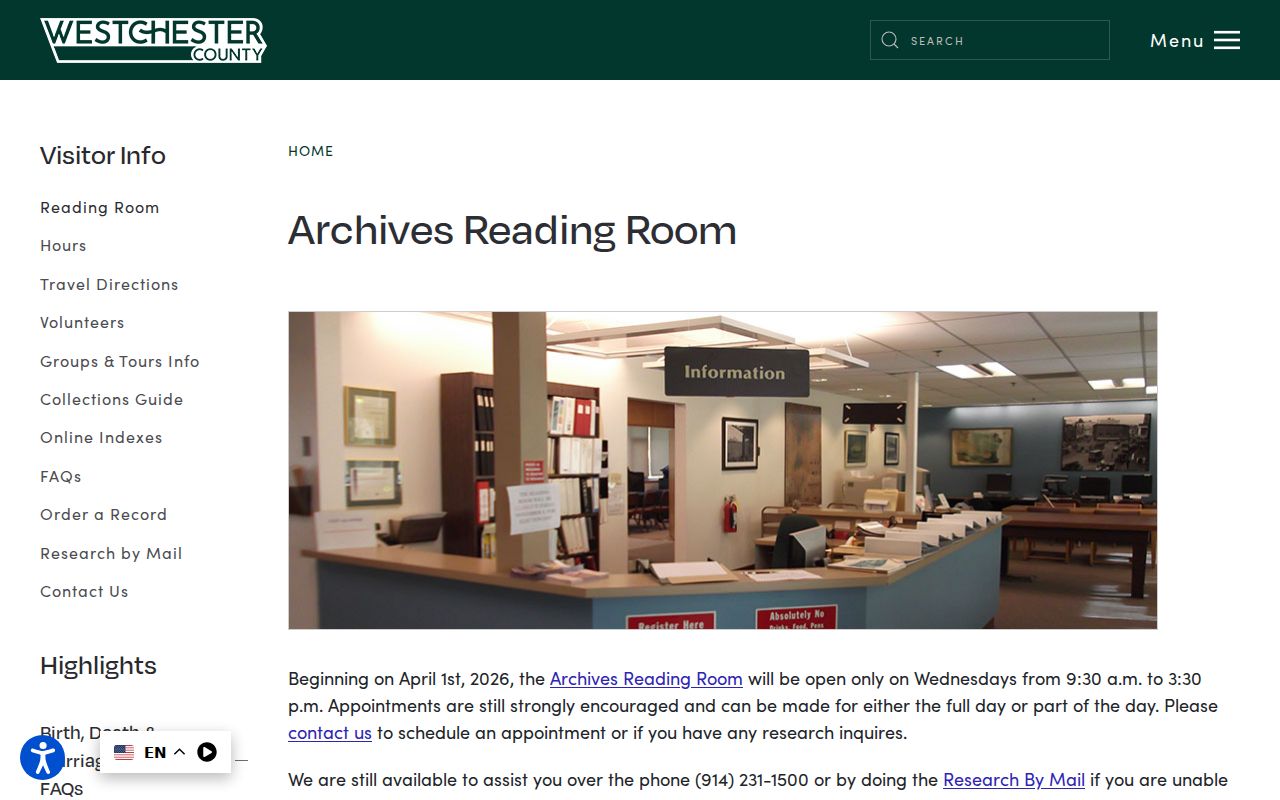
Archives access can extend a historical inquiry, but a catalog or index hit does not establish that every underlying page is available online.
Yonkers Previous Residents in Directories
The Riverfront collection has the exact address-oriented materials needed for selected periods: reverse directories for 1895-1900 and 1900-03, then criss-cross editions for 1931, 1936, and 1939. Those editions are useful when the address is known. The broader city-directory shelf has bound volumes beginning in 1858 and 1866, plus a broken microfilm run through 1939. It is onsite reference material with appointment contact through the Local History Room.
The historical collection itself is described on the Yonkers city directory page. For a previous-residents question, use the directory result as one dated household clue, then compare it with a deed, map, newspaper, or another independently dated source.
YPL's city-directory holdings page identifies the particular reverse and criss-cross years.
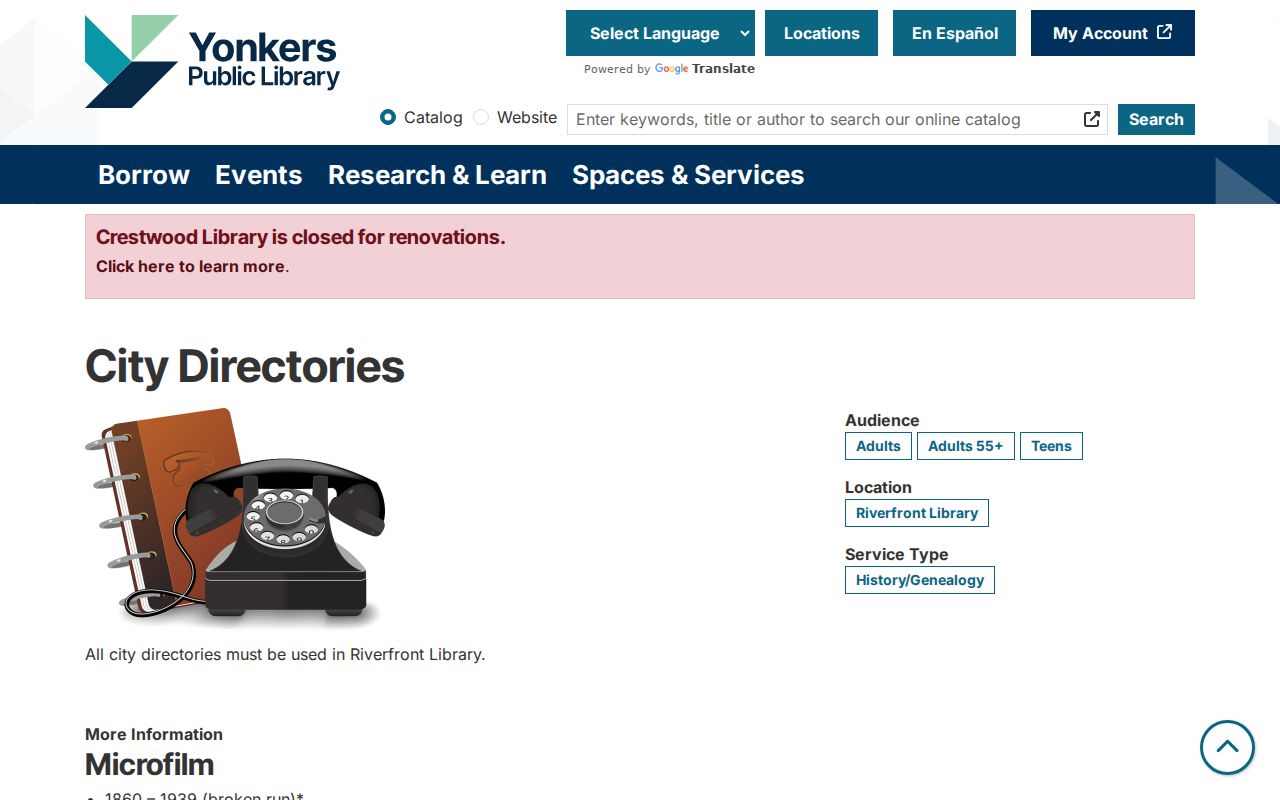
Choose the edition that matches the time period. A reverse directory is not evidence for an address in a year the collection does not document.
Yonkers Maps Explain the Building
Sanborn material can clarify built context without naming occupants. Westchester Archives lists Yonkers Sanborn holdings for 1886, 1898, 1917, a 1917 edition updated to 1951, and 1957. The Library of Congress has the 1917 Yonkers volume, including 126 sheets in volume 2. These maps can help identify structures and street-block context across time.
Use the map date beside the directory or deed date. A map speaks about buildings and layout, not about every person who lived there. The same care applies to the Park Hill Register, which supports searches by address, named place, architecture, date, source text, deed reference, and landmark status. It is a local built-environment index, not a title report.
Pairing Yonkers Directories and Census
Owners are only one part of an address history. A dated city-directory entry can supply a name and address clue, then census schedules and other period sources can help test household context. Start with the exact directory edition, preserve the printed spelling, and compare the record date before connecting people with the same surname.
- Choose the closest available directory year and copy the entry with its page reference.
- Check whether a reverse or criss-cross edition exists for that address and period.
- Pair the directory date with the relevant released census schedule rather than treating a distant census as a match.
- Use a local newspaper with a date, event, or place to test the association.
- Record gaps, conflicts, and alternate spellings instead of silently resolving them.
Riverfront's onsite newspaper holdings include the Examiner, Statesman, Gazette, Daily Record, Herald, and Herald Statesman runs, with a digitized subset of Examiner and Gazette pages. OCR absence is not proof of absence from Yonkers.
Yonkers Estate Clues and Archives
Estate material can add a dated lead at the end of an address trail, but it does not create a household list. The Westchester County Archives Surrogate Records Index lets a researcher use last name, first name, year, or surname-initial browsing. Its instructions allow partial name or year input. The result shows whether the Archives has a record or will of interest, not that all estate papers are digitized.
For current or later Surrogate matters, WebSurrogate has party-name, file-number, old-index, index-book, and will-search modes. Public online document links are limited to unrestricted documents filed on or after February 19, 2014; older unrestricted documents may require public-access computers at the relevant court. Record the file number and ask the correct custodian about access.
Yonkers Local History Room Access
Riverfront is a practical stop when the address trail reaches a directory, yearbook, clipping file, map, or microfilmed newspaper. The room's holdings do not circulate and it is not freely accessible. Contact localhistory@ypl.org or 914-375-7966 for the current appointment procedure and identify the address, date range, and collection type before arrival.
YPL's Local History and Genealogy page describes the reference collections and onsite research services.
A clear request for a specific year or address gives staff a usable historical target without overstating what a directory, map, or archive index can prove.
Limits on Yonkers Previous Residents
Previous residents, past owners, mail recipients, and directory listings are not interchangeable. The City Property Finder and county parcel layer distinguish property situs from owner and mailing categories. A recorded deed is dated, while an assessment roll is a municipal snapshot. A directory is a dated publication with documented gaps. Each source needs a date, a role label, and an independent check.
Lawful use. Yonkers address history is appropriate for family history, property research, estate questions, and personal curiosity. Respect protected addresses and confidential records, and do not use historical material to track, threaten, or harass a living person.